What Does It Mean to Be a Liberal Arts College in 2019
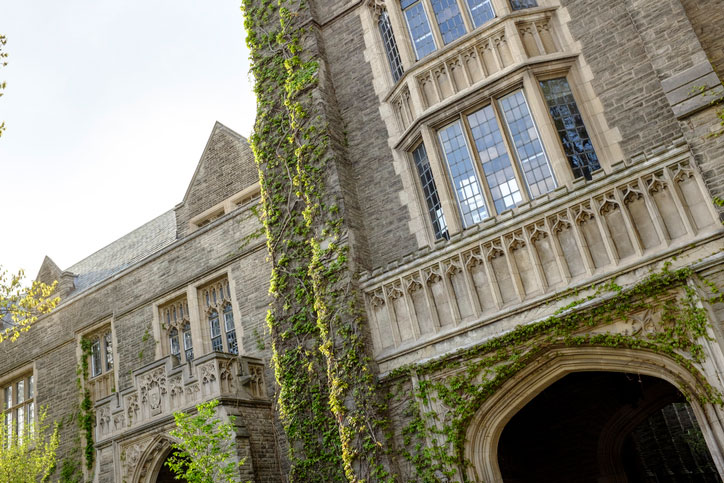
Although almost every 4-year academy in the United States offers an education that is rooted in the liberal arts tradition, they aren't all considered liberal arts universities. In the most general sense, liberal arts colleges are institutions that don't take a distinct vocational or professional runway focus, but instead offer a more interdisciplinary didactics that covers many fields.
But at that place's really no precise definition for what a liberal arts college is or is not. The term has taken on a life of its own as a kind of shorthand to describe schools that offer a well-rounded by generally less technically focused college experience. There'due south no hard and fast rule for how to use the term liberal arts college, but in the truest sense, these schools tin always be recognized by a few traits:
- Potent Humanities Courses
- Encourage Creativity and Exploration
- Personal Connections Are Emphasized
- Small Class Sizes
The term liberal arts college gets thrown around a lot in higher education, but what does "liberal arts higher" hateful?
You may already know that liberal arts is a broad term. It encompasses a wide range of fields, from English to psychology to economic science, while also describing a particular philosophy of education: a commitment to enquiry, rational discussion, and creative problem-solving.
And you're already familiar with a liberal arts didactics, because that's exactly what most American K-12 schools offer, then you've actually been getting an education in that tradition from the fourth dimension you were in kindergarten. A wide range of classes in different subjects is standard. Didactics kids to think is the primary mission, not just cramming facts. The same is true at the college level.
What Does Liberal Arts College Mean?
So, if you've had a liberal arts education almost of your life, you lot may be wondering what does liberal arts college hateful, really? Creative thinking volition serve yous well as you dive into it…
A Liberal Arts College Has Strong Humanities Courses
Liberal arts wouldn't be liberal arts without the humanities. These academic disciplines cover the classics, including:
- Classical Civilization
- Literature
- Philosophy
- History
- Archeology
- Anthropology
- Religion
- Art
The departments that offer those courses at a liberal arts higher are typically some of the largest and most respected. While large enquiry colleges might tend to treat them as box-checking exercises on the mode to professional studies, a liberal arts college makes humanities courses their métier.
Liberal Arts Colleges Encourage Creativity and Exploration
Teaching thinking skills is the main goal at liberal arts schools, and then await to find programs that force you to recall outside the box. You're likely to detect experimental approaches such as designing your own curriculum or an accent on experiential learning. Liberal arts schools often offer overseas learning experiences to encourage travel and exploration of other cultures.
Attitudes amidst instructors are some of the defining elements of what the liberal arts higher feel is all about. Y'all're less likely to detect your ideas and suggestions shot downward, and more likely to have professors who encourage the exploration of original thought and creative ideas.
Although yous'll get a lot of cantankerous-disciplinary noesis thrust upon you, didactics isn't purely prescriptive at a liberal arts higher.
All of this is designed to build confidence in your own critical thinking and reasoning skills. You'll receive a lot of support when information technology comes to developing your own thoughts and judgements through your studies.
Give-and-take and Personal Connections Are Emphasized at Liberal Arts Colleges
The style that instructors approach their jobs is dissimilar at liberal arts schools. Lecture and didactic pedagogy styles are out; fostering a spirit of enquiry and getting students to teach themselves is in.
That means developing existent and personal connections with students, and encouraging discussion and debate. A liberal arts college is a place where you can await to engage non but with other students in your courses, but besides with faculty. In the halls, in classrooms, at the student union… you can await to run into engaging, interesting people and have fun conversations with them at a liberal arts higher.
This connectedness oftentimes extends well past graduation, too. Alumni groups are tight and networks are far-flung and diverse. All those different interests take off in unlike professional directions, so you lot can count on your class reunions being chock full of a lot of interesting stories from quondam classmates.
Modest Grade Sizes are Standard at a Liberal Arts College
 All those personal connections are fostered past class sizes that are smaller than boilerplate.Co-ordinate to 2019 data from the National Center For Education Statistics, the average ratio of students to faculty at public universities—near of which are not considered liberal arts colleges—is 15 to ane. At private non-turn a profit universities—many of which are liberal arts colleges—that ratio is simply ten to ane.
That means instructors are not spread as thin and have fewer students per course and more time per student to offer individual attending. And with fewer students per course, information technology also becomes easier for you to become to know your fellow students.
All of these factors come together to paint a moving-picture show of what a liberal arts college is today.
A Basic Checklist For Determining What'due south a Liberal Arts Higher—Probably
A liberal arts education will teach y'all pretty quickly to avert speaking in absolutes. In the same way, you won't find some hard and fast rule nearly what a university absolutely must accept in order to qualify as a liberal arts college. Instead, you can call up of information technology as a scale, where some schools lean more in the direction of a liberal arts college.
You tin can run down the checklist of the fundamental characteristics of a liberal arts education to get a sense of where a school might fall on that scale:
- A liberal arts college typically focuses on undergraduate education - While liberal arts schools may offer master of liberal arts degrees, most of their degree focus is likely to exist at the bachelor's level, with some principal's degrees offering advanced tracks building on undergrad curriculum. There will be less accent on postal service-graduate studies and research than in other schools.
- A liberal arts college primarily grants traditional liberal arts degrees - Near of those bachelor's degrees will be granted in humanities subjects, with the big ones typically existence English, history, and languages. Virtually of those programs volition grant Available of Arts versus Bachelor of Science degrees. And many of the degrees conferred will be truthful liberal arts degrees by name, covering all these areas more broadly, as is the instance with a BLS or Available of Liberal Studies.
- A liberal arts college is probable to be a private university - Considering of the costs of maintaining high-quality faculty and the privilege of offering unorthodox, non-professional programs, near liberal arts colleges are privately-endemic, not-profit institutions.
- A liberal arts college has pocket-sized pupil bodies - In keeping with the need for small form sizes and interpersonal relationships, the overall educatee population at liberal arts colleges tends to be small, oftentimes with but a couple g matriculating students.
- A liberal arts college has dedicated alumni and satisfied students - Because they are modest, liberal arts colleges are often aristocracy. That makes for strong alumni associations and close, life-long ties among students. Students also report being happier with their education at these universities.
- A liberal arts college can be uniquely focused on building a school community - High concentrations of artistic people and open-minded administrators can make for some unusual campus traditions. Tinker Day at Hollins University, for instance, involves cancelling course on a random fall day and having about of the faculty, students, and staff hike up a nearby mountain for an impromptu picnic with outrageous costumes. Brown has the Naked Donut Run.
Columbia'due south Orgo Nighttime has most of the student body invading Butler Library, where organic chemistry students traditionally study for their last exam, with the express purpose of disrupting those studies with music and skits.
What does liberal arts higher mean? The answer to this question is ever, in a style, relative to the total landscape of higher options. Those that put more focus on producing well-rounded, critical thinkers and artistic trouble solvers than on purely technical or professional person track degrees could rightly be considered liberal arts colleges.
In the end, your liberal arts reasoning and analysis skills are the perfect arroyo to answering the question: what is a liberal arts college and what is not?
Source: https://liberalartsedu.org/faq/what-is-a-liberal-arts-college/
0 Response to "What Does It Mean to Be a Liberal Arts College in 2019"
Post a Comment